
I used to think burnout was the enemy. You know the drill, working 80-hour weeks, running on caffeine and adrenaline, telling yourself you’d slow down “after this next project.” I was wrong about what was really killing my leadership effectiveness.
The real saboteur wasn’t burnout. It was the thousand tiny energy leaks that happened long before I ever felt “burned out.”
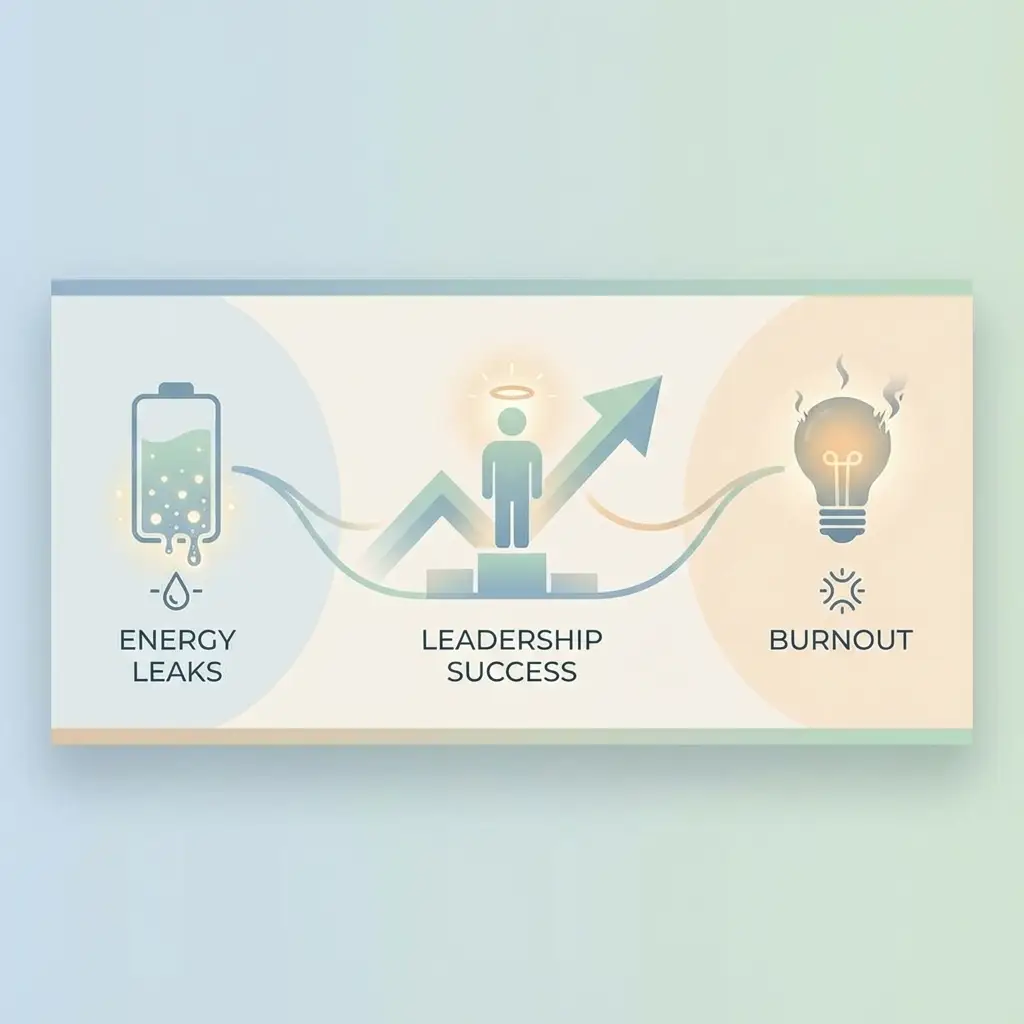
Here’s what I wish someone had told me fifteen years ago: Burnout is just the final destination. Energy leaks are the route you take to get there.
What Energy Leaks Actually Look Like (From Someone Who’s Been There)
Energy leaks aren’t dramatic. They’re not the obvious stuff like working weekends or skipping vacation. They’re subtle, normalized, and absolutely devastating to your leadership presence.
I remember sitting in my office one Tuesday afternoon, completely drained after what should have been a productive day. I’d had six meetings, responded to 47 emails, and somehow felt like I’d accomplished nothing meaningful. That’s when it hit me, I wasn’t suffering from too much work. I was bleeding energy from a thousand tiny cuts.

The meeting that could have been an email. The Slack notification that pulled me out of deep work. The colleague who “just needed five minutes” that turned into thirty. The decision I made three times because I didn’t trust my first instinct.
These energy leaks compound. They don’t just steal your time, they steal your capacity to think clearly, lead decisively, and show up as the leader your team needs.
The Burnout Trap Most Leaders Fall Into
Burnout gets all the attention because it’s dramatic. It’s the breakdown, the breaking point, the moment you realize you can’t keep going. But here’s what I’ve learned after working with hundreds of entrepreneurs: burnout is a symptom, not the disease.
The disease is how we’ve designed our leadership lives. We’ve created systems that guarantee energy depletion, then act surprised when we hit the wall.
I used to wear my burnout like a badge of honor. “Look how hard I’m working for this company.” What I didn’t realize was that my burnout was actually making me a worse leader, not a better one. When you’re running on empty, you make reactive decisions. You lose strategic thinking. You become the bottleneck instead of the catalyst.
The Real Question: Are You Leaking or Breaking?
Most leaders can’t tell the difference between energy leaks and burnout because they’ve never learned to pay attention to their internal state. They’re so focused on external metrics, revenue, growth, productivity, that they miss the internal signals that predict everything else.
Energy leaks feel like:
- Constant mental chatter
- Difficulty prioritizing
- Making the same decision multiple times
- Feeling busy but not productive
- Sunday night anxiety about Monday morning
Burnout feels like:
- Complete emotional exhaustion
- Cynicism about work that used to excite you
- Physical symptoms (headaches, insomnia, getting sick more often)
- Feeling disconnected from your purpose
- Nothing seems to matter anymore
The key insight? Energy leaks are fixable in real-time. Burnout requires recovery time you probably don’t think you have.

Which One Is Actually Sabotaging Your Leadership?
Both. But they work differently.
Energy leaks sabotage your leadership performance. When you’re constantly context-switching, responding to other people’s priorities, and operating in reactive mode, you lose the mental space required for strategic thinking. Your team starts coming to you with problems instead of solutions because you’ve trained them that you’re always available for interruption.
Burnout sabotages your leadership presence. When you’re emotionally depleted, your team feels it. They start walking on eggshells. Innovation dies because people are afraid to bring you problems. Your decision-making becomes erratic because you’re operating from scarcity instead of abundance.
But here’s the thing, energy leaks always come first. I’ve never met a burned-out leader who didn’t have massive energy leaks for months or years before they hit the wall.
The Energy Audit That Changed Everything
About three years ago, I started tracking my energy the same way I tracked my finances. Every interaction, every decision, every context switch, I asked myself: “Did that give me energy or take it?”
The results shocked me.
40% of my “productive” activities were actually energy drains. Meetings with no clear agenda. Email responses that created more emails. Decisions I made when I should have delegated. Conversations with people who consistently left me feeling depleted.
I realized I’d been managing my time but not my energy. Big mistake.
The Practical Fix (That Actually Works)
The solution isn’t work-life balance. It’s energy architecture, designing your leadership role to naturally replenish your energy instead of constantly depleting it.
Energy Audit Weekly: Every Friday, spend 10 minutes reviewing your energy patterns. What gave you energy this week? What drained it? What patterns do you notice?
Boundary Design: Instead of trying to say no to everything, design your yes. What types of meetings, decisions, and interactions naturally energize you? How can you structure more of those?
Recovery Rhythms: Most leaders think recovery happens on vacation. Wrong. Recovery happens in micro-moments throughout your day. The two-minute breathing space between meetings. The walk to get coffee without your phone. The moment you actually stop and appreciate progress instead of immediately moving to the next problem.

What This Means for Your Leadership
When you stop the energy leaks, everything else gets easier. Decision-making becomes clearer because you’re not operating from depletion. Strategic thinking becomes natural because you have the mental space for it. Your team starts bringing you solutions instead of problems because you’ve created an environment where innovation feels safe.
Most importantly, you start leading from intention instead of reaction.
This is exactly what we’ll be diving deep into during our 5-day challenge starting January 12th. We’re not just talking about energy management: we’re redesigning how you show up as a leader so that your default state is energized, focused, and intentional.
The Bottom Line
Energy leaks are sabotaging your leadership right now. Burnout is what happens when you ignore them long enough.
The good news? You can fix energy leaks starting today. You don’t need a sabbatical, a retreat, or a complete life overhaul. You need awareness, intention, and a system that works with your leadership reality, not against it.
The question isn’t whether you have energy leaks: every leader does. The question is whether you’re going to keep ignoring them until they become burnout, or whether you’re ready to do something about them.
Your team, your company, and your future self are counting on your answer.